Showing posts with label Clifton Webb. Show all posts

Saturday, May 23, 2026

The Winner Changes All: Best Supporting Actor, 1944

Presenting the 17th Academy Awards' nominees for Best Supporting Actor:

Hume Cronyn, The Seventh Cross
Barry Fitzgerald, Going My Way
Claude Rains, Mr. Skeffington
Clifton Webb, Laura
Monty Woolley, Since You Went Away

Cronyn is a man in Nazi Germany who must choose between protecting himself and helping a friend, a political refugee. Fitzgerald is an old and old-fashioned priest with a crumbling parish. Rains is a successful Jewish businessman who marries a woman who loves his money more than him, but he's hopeful that'll change. Webb is a bitchy columnist whose protege's murder is investigated. Woolley is a stuffy retired colonel boarding with a middle-class family, nursing a strained relationship with his grandson.

This was always going to be Fitzgerald's Oscar:


The fact that he was nominated for the exact same performance in Best Actor tells you so. At the time, Academy bylaws permitted an actor to be considered for whatever category, and he happened to score enough votes to place in both categories. Afterward, rules were changed so that an actor could only be nominated in the category submitted by their studio, but that got confusing, too: a clerical error in 1963 led to the entire cast of Cleopatra being submitted as leads, while Peter Sellers' multiple roles in 1964's Dr. Strangelove led to four simultaneous campaigns: one in Lead for all three roles together, and three in Supporting for each role individually. So then the rules were changed again: you could vote for a role in whichever category, but the category they got the most votes in first would be their nomination: thus, Kate Winslet in The Reader went from being campaigned all 2008 as Best Supporting Actress, only to wind up in Best Lead Actress.

So that's how a Supporting Actor won the Oscar and changed the rules.

It's not, admittedly, the best lineup. My rankings, from fifth to first:

Thursday, July 13, 2023

1948: Best Actor

The question that haunts this category for this particular year: where's Humphrey Bogart's nomination for The Treasure of the Sierra Madre


From the Los Angeles Times: "There is nought but credit to give to the actor for his very fine performance. He has a terrific dramatic summit to reach in the later scenes, and does this with notable effectiveness." From the New York Times: "His performance in this film is perhaps the best and most substantial that he has done." From Variety: "Bogart...comes through with a performance as memorable as his first major film role in The Petrified Forest was in 1935. ...In a remarkably controlled portrait, he progresses to the edge of madness without losing sight of the subtle shadings needed to establish persuasiveness."

To many, this is the performance Bogart should have won for (possibly clearing the way for a Brando win in 1951). Perhaps the reason for Bogart's absence is the about-face. Every review notes that his fans may be disappointed to find that instead of another "indestructible private eye" or flawed good guy, he plays a real asshole. Allegedly, he himself told a critic weeks prior to the film's opening, "I play the worst shit you ever saw." It's a great performance but a challenging part, one that perhaps fans weren't ready to see and co-workers weren't ready to award.

Here's who got nominated instead:

Wednesday, October 26, 2022

1946: Supporting Actor

Even the Academy didn't expect this year's winner to triumph! 

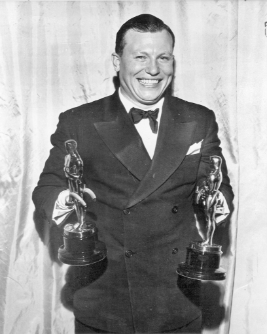
Harold Russell did not pursue the acting life. He was living the modest life of customer service, enlisting in the Army after the attack on Pearl Harbor. Serving as an instructor at Camp McKail, a freak accident during demolitions training took both his hands. Now outfitted with hooks, Russell was featured in a documentary short about his rehabilitation, "Diary of a Sergeant." It was seeing that film that inspired William Wyler to cast Russell in The Best Years of Our Lives - that, and Wyler's determination to fill the cast and crew with as many veterans as possible. Russell was lauded for his performance, but when the Oscar nominations came out, he was seen as a longshot. After all, he was up against a number of older, more experienced performers, only one of whom had ever won. It is said that that was why the Board of Governors bestowed on him an Honorary Award, separate from the competitive nod, in recognition of his "bringing hope and courage to his fellow veterans through his appearance in The Best Years of Our Lives."

And then he actually won the damn thing, making him the first non-professional to win an Oscar and the only actor to win two Oscars for one performance.


What was the competition like? Here 'tis: