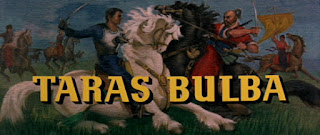
Each category always seems to have one lone nominee, the sole representative of a film that, perhaps, had greater Oscar dreams. I'm sure the lone nominee in this category had higher aspirations: Taras Bulba.
Based on the novel by Nikolai Gogol, Taras Bulba is the story of a family. Taras is a proud Cossack, a ferocious military leader, an enemy of the Poles, a friend as well a father to his sons. His sons Andriy and Ostap are educated in Kyiv, where Andriy falls in love with a Polish noblewoman. This leads to some tensions when the Cossack take arms against the Polish government. Exciting battle scenes, with so many horses, extras, and pyrotechnics, you'll thrill even as you worry for everyone's safety! A bear pit! Lots of drinking and singing! Great performances!
And, of course, a sweeping, epic score - let's discuss further:
This year's field was dominated by Best Picture nominees: Airport, Patton, and the winner, Love Story:
Two exceptions, though, one from a newbie, the other from a veteran of the game...
Cromwell is a historical drama in the vein of Anne of the Thousand Days or A Man for All Seasons, depicting the clash between statesman Oliver Cromwell and King Charles I - a clash that included Civil war, the execution of the King, and Cromwell's becoming head of state and government. It feels like a film made for those who already know the history, with the many people and their titles and their loyalties increasingly difficult to track - I know there's betrayal and double-crosses and whatnot, but I could not for the life of me figure out who was betraying or why. Hoarse Richard Harris disappoints; Alec Guinness is great. This was one of the film's two nominations; it won for Costume Design.
Sunflower is a drama about a woman who refuses to believe her husband, declared MIA, died in war; she searches for him in the Soviet Union and uncovers the shocking truth. Sophia Loren (who this year, returns to cinema in Netflix's The Life Ahead) is quite gutting in the film. Otherwise, I wasn't too crazy about it. I don't mind its score, though, which you can hear, alongside the other nominees, right here:
Here are three scores that one assumes almost made it - they were, after all, nominated or awarded elsewhere - but didn't make the final cut. Each album cover will bring you to the score's playlist on YouTube, so treat yourselves!
From left to right, you're looking at the Golden Globe-nominated score to 1492: Conquest of Paradise by Vangelis, the LAFCA Award-winning score to Damage byZbigniew Preisner, and the BAFTA Awards- and Golden Globe-nominated score to The Last of the Mohicans by Trevor Jones and Randy Edelman.
Great work, but not the nominees! The nominees are:
The music branch of the Academy seems to be the most insular, exclusive group. Like every category, there's usually one newcomer a year, but the rest of the nominees tend to have an unusually high tally of previous nods. The record for most Academy Award nominations is held by a composer, and soon it will become clear who (as if you didn't already know!).
I break the nominees up like so:
Welcome to the Club - My goodness, they actually let some "new" blood in, and look who it is: Ravi Shankar and George Fenton sharing a nom in 1982 (Fenton would return), Jonny Greenwood in 2017 (and I should mention, Shankar and Greenwood are both best-known around the world as popular music figures)
Old Friend - Prolific, but not in the double-digits yet, and a winner who keeps doing great work: Marvin Hamlisch in 1982 (he had two wins in one year) and Alexandre Desplat in 2017 (recently won for The Grand Budapest Hotel)
Prolific Bridesmaid - It feels like he's always here, yet despite his reputation, he's actually only won once before, if at all: Jerry Goldsmith in 1982 (12th nominationforscoring, previous winner for The Omen) and Hans Zimmer in 2017 (11th nomination, previous winner for The Lion King)
Second Time's the Charm - Just when you thought he was a one and done, he comes roaring back: Jack Nitzsche in 1982 (previously nominated for One Flew Over the Cuckoo's Nest, also up for Best Original Song this year) and Carter Burwell in 2017 (previously nominated for Carol)
John Williams - You can't getrid of him! Fifty-one nominations total, 46 in scoring alone, most recently 2017's The Last Jedi! 1982's E.T. the Extra-Terrestrial got him his fourth Oscar (hehasfive).
Let our ears feast upon their work, after the jump......
To the theme from The Rose, out comes Bette Midler, quick to skewer the proceedings with some light blue humor, a dig at the People's Choice Awards, and even good-humored calling-out of people who insist on "whoo-ing" for their favorites:
See how her eyes just light up when she reads the winner's name aloud! And dig how that fine-ass Mr. Hancock is adorably nervous at first, then delivers an elegant tribute to Jazz, "this American-born artform" for which "praise has long been overdue".
But, you know, I have my own tastes - or lack thereof, depending on how you feel about this category! The nominees for Best Original Score, in the reverse order of how I'd rank them; bottom's up, in other words. After the jump....
It is incredible that the category of Best Original Song has lasted as long as it has. It is possibly the most expendable category at the Oscars. I know people who think the ceremony runs too long always suggest moving the Short Categories to the Governors Awards, but at least those serve as calling-cards for obscurer filmmakers.
But Original Song? It is not like it was in the 1930s, when musicals were as common as romantic-comedies and a song was as much a part of the studio package as a leading lady and a happy ending. When was the last time the winner even played on the radio? Outside of a dance remix? You know Justin Timberlake isn't going home with the Oscar this year!
Still, it makes for an entertaining category, a fun diversion during the ceremony, and a chance for Neil Diamond to accidentally call Ayn Rand a nominated songwriter:
(It's kind of bad form for Diamond to openly root for Barbra, but very gracious of her to cede the mic to Paul Williams)
So, consider this a musical break - the nominees, with video, after the jump.
Original Score looks wonky as hell in 1976, and that's for a very good reason: Best Picture was populated by minimalism. All the President's Men has a moody score that doesn't kick in for thirty minutes; Network does not have a score at all. Bound for Glory uses its score sparingly, and even so, it's all Woody Guthrie songs - therefore, it has no business being here. Only Taxi Driver and Rocky could boast traditional scores, noticeable scores, scores that would go down in history as two of the most iconic of all time. No wonder both found themselves nominated right here!
Haha, just kidding. Bill Conti's Rocky score was left out in the dust, just as Ludwig Goransson's for Creed would be 39 years later. And baby, I don't know why that is. It couldn't be the bombast - Obsession isn't exactly about subtlety, you know? It couldn't be that its theme is mostly within the context of original song "Gonna Fly Now" - The Omen made it in both categories, after all. It couldn't be its unabashed Americana - The Outlaw Josey Wales is filled with fifes and drums and patriotic-sounding...ah, but wait. There was an irony there, given the central conflict between the titular outlaw and his country, both North and South.
But then one remembers that Bernard Herrmann had died the year before, Christmas Eve 1975. And Herrmann was a man who'd been under-appreciated by the Academy. Oh sure - three previous nominations, with one resulting in a win, but that was it. And not one of those movies was Psycho or Vertigo or Beneath the 12-Mile Reef or Jason and the Argonauts. Thus he gets in twice - including one for Obsession, a riff on his Vertigo theme.
As for the other three slots? Goldsmith was a frequent presence at the Academy Awards, having been nominated for A Patch of Blue, Planet of the Apes, Chinatown, The Wind and the Lion, and oh so many more. Hell, he'd be nominated another eight times after this, including for Under Fire, which he lost to...Bill Conti. But only one of those nominations would result in a win. This very one:
And then there were Lalo Schifrin, his third nomination for a disaster epic that was, for a time, catnip in this category; and Jerry Fielding, on his third final nod following The Wild Bunch and Straw Dogs.
I've always found it a challenge to write about this category - it's to be heard, to be experienced. Though I suppose there is something to be said about this category having its favorites, as many do. It's how John Williams can get a third nomination for one series - of course, he would return for a fourth (The Force Awakens), and let us not forget that Jedi was his 19th overall nod....outof50.
Williams had wonOscars already -- but so, too, had fellow nominee Leonard Rosenman, though both of his were in the Adapted Score category (Barry Lyndon, Bound for Glory). Another two-time Oscar winner was Michael Gore, who won this category, and Original Song, just three years previously for Fame. Poor Jerry Goldsmith - the Under Fire composer only had one Oscar to console himself with!
The odd man out, clearly, was Bill Conti, who in years past had only been nominated for Best Original Song. The first time for Rocky, and yes, it is incredible that it was only nominated in Song, not Score. The second time was for the Bond flick For Your Eyes Only. The Right Stuff marked his third nomination, first Original Score nomination...and final time in the running for Oscar.
Fortunately for him, he won. Should he have? Let's investigate....
Let's take some time to listen to some music, shall we?
Alex North for The Agony and the Ecstasy
***
It's lovely, the right mix of epic, intimate, and holy. It's your typical roadshow sound, really.
Maurice Jarre for Doctor Zhivago
*****
Now this is how you do an epic roadshow score! "Lara's Theme" sweeps you into the romance, revealing itself in unexpected moments -- like a moon shining in the sky, a beacon showing the way.
It's funny: the more things change, the more they stay the same. In 1974, this category saw honors for Richard Rodney Bennett, Alex North, John Williams, Jerry Goldsmith and Nino Rota & Carmine Coppola, who scored the eventual Best Picture winner. In 1975, we're now looking at a line-up that includes Gerald Fried, Alex North, John Williams, Jerry Goldsmith and Jack Nitzche, who scored the eventual Best Picture winner. As always, Goldsmith's and Williams' scores have stood the test of time, with both up for AFI's 100 Best Film Scores (only Jaws placed).
Gerald Fried for Birds Do It, Bees Do It
ABSTAIN
I will never understand how an Academy Award-nominated film can go unreleased in any home viewing format. It boggles the mind, and reduces the film to a footnote.
Alex North for Bite the Bullet
***
This year was full of hat-tips to genres past, and North's Classic Western score is no exception. Shades of Aaron Copland in this perfectly fine, solid piece of work. It doesn't distinguish itself as much as the other nominees, but it's not to be sniffed at.
John Williams for Jaws
*****
Instantly iconic. Everyone knows what you mean when you go "duhn duhn duhn duhn, etc." But we shouldn't forget the more adventurous music played for the Orca, music that calls back another era of filmmaking and turns the men's trip into a high-seas adventure...before returning to the relentless repetition of those damning strings.
Jack Nitzche for One Flew Over the Cuckoo's Nest
****
Its Native American influence hints at the novel's origins, as it provides the connection between Chief Bromden and Randle McMurphy. A simple tune, it's calming at the beginning, triumphant near the end, and haunting well afterward.
Jerry Goldsmith for The Wind and the Lion
****
Where Milius fails, Goldsmith succeeds. Exciting and exotic, the score provides the adventure, romance and depth lacking elsewhere in the film. Paves the way for future adventure scores from Raiders of the Lost Ark to the remake of The Mummy. The kind of music that gets your blood pumping and turns the most mundane of tasks into a mission.
------------------------------------------------
I have to admit, Oscar usually does me proud in this category, and I'm going with its proclamation that the Award for Best Original Score belongs to:
One problem I've never been able to get over is my dislike for saxophone in noir films. It seems to always show up in scores to neo-noirs, yet I can't for the life of me think of a precedent for it. Many of the original noir films had those big Elmer Bernstein orchestras, didn't they, like any other Hollywood film of the time? Someone point out to me the exceptions, because I can't think of any.
Anyway, I didn't care for Goldsmith's score, and I think it isn't needed except for the opening credits. Hell, there's barely a score in the movie anyway, right? That's one of the things I love about Chinatown, it's naturalistic take on the noir genre. Then, here and there, the score comes up again, and while I don't hate it, it's not my cup of tea.
Nino Rota and Carmine Coppola for The Godfather: Part II
*****
I feel like I would pick a fight with anyone who doesn't like the score to these films. Rota brings the old themes back with beautiful new work, and Carmine Coppola (father of director Francis Ford) adds some great work to complement him. Coppola's work can mostly be heard when young Vito is in New York, the most notable track coming during a neighborhood Catholic festival during which Vito makes a significant move to power. Rota, of course, is still giving us that immortal trumpet theme, but gives Vito his own theme, as well.
Really, it would still be amazing if it was the same old music from the last film. But it isn't, and the result is just as high-five worthy.
Richard Rodney Bennett for Murder on the Orient Express
****
Sidney Lumet was very clear that everything have a capital letter in his vision of Agatha Christie's whodunit. The performers Acted while wearing Costumes and walking amongst Production Design. So, naturally, Bennett wrote an Original Score, beginning with a loud, cymbal-crashing opening theme that sets the mood just perfectly. Eerie strings punctuate the unfolding of a child kidnapping/murder case. The jaunty Orient Express theme has the energy and glamor of a train ride with Lauren Bacall. The greatest crime is that the idea for an opening song was scrapped. If only!
Alex North for Shanks
***
Shanks is an odd little film, a semi-silent flick starring Marcel Marceau and his fellow mimes, in William Castle's final effort as director. It's beautiful and funny, and more than a little uncomfortable -- I'm pretty sure the 50-year-old titular puppeteer and the 15-year-old girl with him are supposed to be in love or something. It's more than a little weird, especially when he starts puppeteering corpses.
Since it does play out like a silent film, title cards and all, this is perhaps the most-scored out of any of the movies on this list -- hell, in this year, probably. The results are mixed, but I have to say it was, for the most part, a great success. The finale works as well as it does because of the music. If it wasn't for North's work, the corpse-puppets would just be creepy. It's really his score that makes this such an effective dark comedy. It's an odd little gem that's worth seeking out, movie and music both.
John Williams for The Towering Inferno
***
Suitably epic in parts, with that groovy 70s-ness for the more intimate moments. There are moments that drag, and I don't think it's as exciting as Williams' own Earthquake score, or as important as Alfred Newman's for Airport. But dammit, you've got John Williams scoring a big, epic disaster flick, so it must be great, right? Oh, sure, maybe a little unmemorable in parts, and maybe you don't even remember there being music in the helicopter scene even though the IMDb trivia specifically mentions it as a point of disagreement that Williams won -- sure, maybe you don't remember stuff like that. But then there's the main title theme and the finale and the theme for Fred Astaire's romance. I only wish it was two solid hours of pure music magic.
-------------------------
UPDATE: How did I forget to weigh in on my vote? Of course, you can see the stars, but just to reassure you, I agree with Oscar.
NINO ROTA & CARMINE COPPOLA
for
THE GODFATHER: PART II
though maybe it should've been in Adapted Score ;)